InSpectro NIR
Inline Near-Infrared Spectroscopy
Why Inline NIR?
Unlike offline or at-line methods, inline NIR probes are installed directly in the process stream — inside an extruder barrel, a blender, a coating drum, or a pipeline. The material flows past the sensor while being produced, enabling continuous monitoring and immediate feedback for process control. This eliminates sampling errors, reduces waste, and unlocks true Quality by Design.
Practical Applications
What can you actually measure with an inline NIR probe? Here are the most impactful use cases across industries.
- Moisture / Water Content
- Residual moisture in polymer pellets
- Drying endpoint in fluid-bed granulators
- Water activity in baked goods and snack production
- Contamination Detection
- Foreign polymer detection in recycling streams
- Chemical adulterants in food ingredients
- Cross-contamination between production batches
- Chemical Composition & Additives
- Plasticizer content in PVC extrusion
- Residual solvent in coatings
- Component ratio in polymer blends
- Blend Uniformity
- API distribution in powder blends
- Additive dispersion in masterbatch mixing
- Homogeneity in dry blending of excipients
NIR is extremely sensitive to O-H bonds, making moisture detection one of the most reliable and widespread inline applications. It is critical in drying, granulation, and extrusion processes where even small variations in water content can affect product quality.
Examples:NIR can flag chemical contaminations or foreign material presence in a product stream, functioning as a continuous quality gate. No manual intervention is required — the system monitors every moment of production.
Examples:NIR quantifies the concentration of additives, plasticizers, residual monomers, or individual components in multi-component blends as they flow through the process. This ensures formulation accuracy and prevents costly batch failures.
Examples:By tracking spectral variability over time, NIR can determine when a powder blend has reached target homogeneity. This is a core PAT application formally recognized by the FDA and essential for ensuring consistent drug product quality.
Examples:InSpectro NIR: ColVisTec's Solution for Inline NIR Spectroscopy
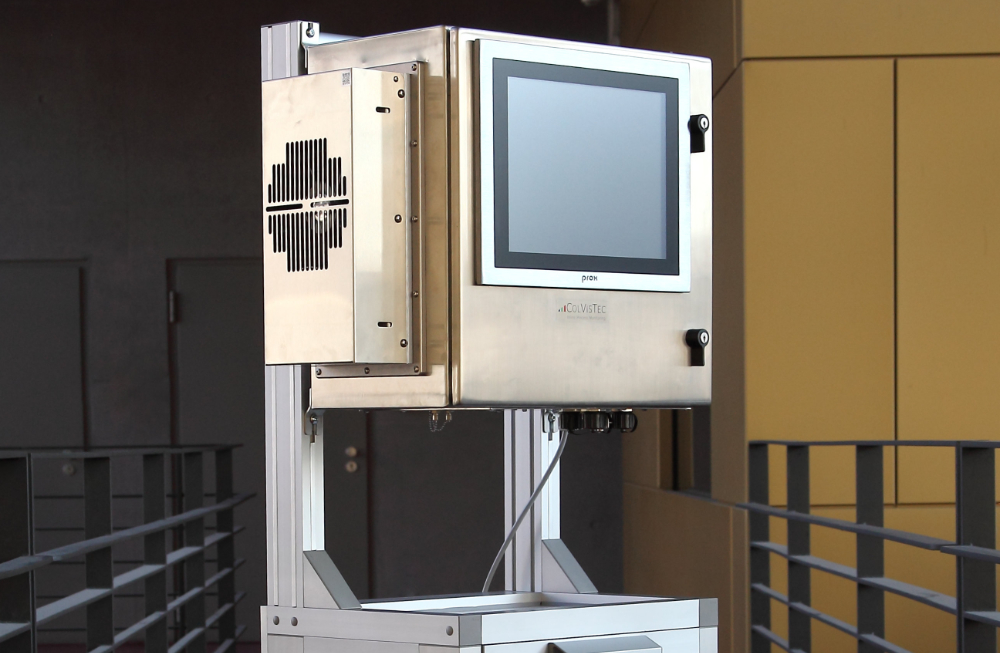
The ColVisTec NIR spectrophotometer operates in the 1000 – 2500 nm wavelength range and delivers real-time analytical data from inside extruders, reactors, mixers, and other process equipment. By continuously "looking inside" the process, it provides 100% control over product quality rather than relying on discrete sampling.
Proven Case Studies
1. Water Content & Throughput Detection in ExtrusionIn a real extrusion trial, the NIR inline system clearly distinguished between water-containing and dry polymer melts:
- Water in the polymer → lower NIR signal level
- No water in the polymer → higher, stable signal
- Lower throughput (100 kg/h) → high signal noise, indicating poor homogenization
- Higher throughput (300 kg/h) → low noise, indicating good homogenization
Within the RecyColor project, the NIR system successfully detected polyethylene (PE) contamination in polypropylene (PP) recyclate, with a linear correlation (R² = 0.91) across a 0–10% PE contamination range. This enables real-time flagging of off-spec material in polymer recycling streams.
Technical Data
- Spectrum: 1000 - 2500 nm
- Slit: 25, 50, 100, 200, 500 μm (replaceable slits)
- Grating: 75 lines/mm
- Blaze: 1 nm
- Spectral resolution: 2.6 nm through 85 nm (depends on slit size and grating)
- Integration time: 10 μs to 5 ms (adjustable)
- Interface for 1 probe
- Light source: broadband 360 - 2600 nm lamp
- Detector: InGaAs Linear Array Detector with 512 pixels
- Dimensions: 610 (W) x 550 (D) x 850 (H) mm - inlcuding standard support and TEHC
- Weight: ca. 90 kg (InSpectro NIR alone: ca. 55 kg)
- Required space: approx. 1m x 1m
- Integrated computer with 128 GB SSD and integrated touchscreen
- Operating system: Windows® 10 IOT Enterprise LTSC
- Interfaces: 3x USB, 1x Ethernet, OPC-UA (server provided)
- Optional interfaces: Serial with Modbus RTU/TCP/UDP
- Voltage: 230 V, 50 Hz, 3 A (EU) or 120 V, 60 Hz, 8 A (US)
- Environment conditions: 5 °C (41 °F) to 40 °C (104 °F) (non-condensing)