InSpectro R
Inline Raman Spectroscopy for Process Monitoring
What is Raman Spectroscopy
Raman spectroscopy is a non-destructive analytical technique that exploits the inelastic scattering of light (the Raman effect) to reveal detailed information about the molecular structure of a sample. When a material is illuminated with a monochromatic laser, a small fraction of the scattered light undergoes a frequency shift that is characteristic of the chemical bonds in the sample: the result is a unique molecular "fingerprint" for every substance. Unlike other analytical techniques, Raman spectroscopy requires no sample preparation, is largely unaffected by the presence of water, and can be performed through transparent materials such as glass or quartz. These properties make it particularly well suited to inline monitoring of industrial processes in real time.
Raman Spectroscopy provides information on:
- Formulation fingerprint – unambiguous identification of raw materials and blends
- Structural properties – distinction between amorphous and crystalline forms, polymorphs
- Tracking of specific impurities – detection of unwanted components
- Finished-product identification and verification of compliance with specifications
Benefits for Quality Control and Industrial Applications
Integrating Raman spectroscopy directly into the production line is a significant step up from traditional manual sampling followed by laboratory analysis.
- Real-time quality control Continuous monitoring makes it possible to detect any deviation from target parameters immediately, enabling timely corrective actions before the process generates non-conforming product. This reduces scrap and the costs associated with rework.
- Pharmaceutical industry In the pharmaceutical sector, where compliance with GMP regulations and the FDA's PAT (Process Analytical Technology) guidelines demands tight process control, inline Raman spectroscopy enables monitoring of synthesis reactions, crystallization processes, API and excipient blending, and uniformity verification of finished dosage forms. The ability to distinguish between crystalline polymorphs is especially critical for ensuring drug bioavailability and therapeutic efficacy.
- Polymers and advanced materials In the polymer industry, the technique enables monitoring of polymerization, extrusion, and crystallinity — parameters that are fundamental to the mechanical properties of the final product. For advanced materials, it supports the characterization of composites, coatings, and thin films during production.
- Chemistry and industrial processes For the chemical industry, continuous monitoring of reactions, concentrations, and component purity makes it possible to optimize yields, reduce raw-material and energy consumption, and improve operational safety through early detection of anomalies.
- Operational and economic advantages
- Reduced manual sampling and lower operator exposure to hazardous substances
- Waste minimization through tighter process control
- Non-destructive analysis – the sample remains intact and can continue through the production process
- Data-driven decision making based on objective, real-time information
- Product consistency and greater uniformity across batches
InSpectro R: ColVisTec's Solution for Inline Raman Spectroscopy
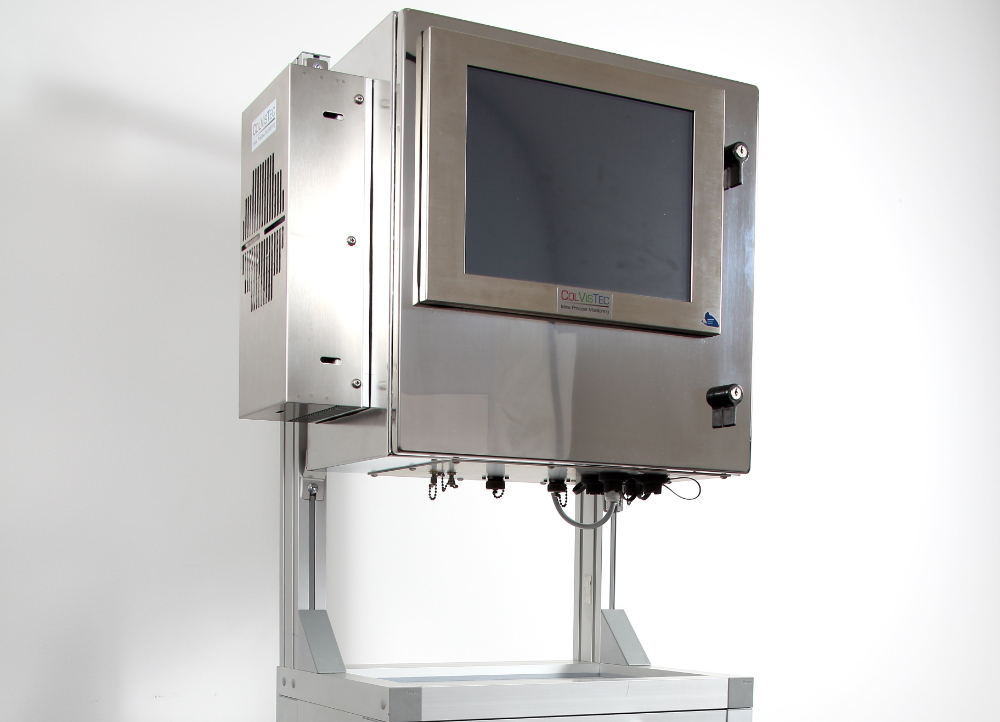
The InSpectro R is a fully integrated inline Raman spectrometer, designed by ColVisTec for demanding industrial environments. It combines high-performance Raman analysis with an intuitive touchscreen interface, housed in a rugged stainless-steel enclosure certified to NEMA 4X (IP66) and able to operate reliably in the presence of dust, vibration, and temperature fluctuations. An advanced thermoelectric heating and cooling system (TEHC) ensures measurement stability and accuracy over time, while fiber-optic technology combined with specialized Raman probes enables precise, non-destructive molecular analysis directly in the process.
Technical Data
- Laser Light Source: 785 nm
- Range of detection: 788 - 1067 nm (Raman Shift: 50 - 3350 cm-1
- Spectral resolution: 0.34 nm FWHM (Raman shift 4.5 cm-1 @ 912 nm)
- Interface for 1 probe
- Integration time: 100 ms to 10 s - adjustable
- Slit: 20 μm
- Maximum intensity at Focal Point: 365 mW
- Optical density: >6
- Fiber Optic Connection: SMA905
- Working distance: 5.5 mm (non-contact sampling)
- Dimensions: 610 (W) x 550 (H) x 850 (H) mm - inlcuding standard support and TEHC
- Weight: 90 kg (InSpectro R alone ca. 55 kg)
- Required space: approx. 1m x 1m
- Integrated computer with 128 GB SSD and integrated touchscreen
- Operating system: Windows® 10 IOT Enterprise LTSC
- Interfaces: 3x USB, 1x Ethernet, OPC-UA (server provided)
- Optional interfaces: Serial with Modbus RTU/TCP/UDP, Analog (Current/Voltage)
- Voltage: 230 V, 50 Hz, 3 A (EU) or 120 V, 60 Hz, 8 A (US)
- Environment conditions: 5 °C (41 °F) to 40 °C (104 °F) (non-condensing)