ColVisTec offers advanced Fiber Optic Probes designed for continuous in situ monitoring of industrial processes. Our product line includes various distinct Probes to cover a wide range of applications.
All of our probes are specifically engineered to withstand harsh environmental conditions, ensuring reliable performance even in challenging industrial settings.
They are suitable for diverse industries — from plastics and polymers, paint, food, and pharmaceuticals to chemical manufacturing — our probes provide versatile measurement options. Depending on the properties of the material, UV-Vis and NIR Probes can be used in Reflection Mode for Opaque Materials or in Transmission Mode for Transparent Materials, allowing precise, continuous monitoring of product quality and critical process parameters to maximize efficiency, stability, and reproducibility.
UV/Vis or NIR
Reflection Probes
The reflection probe — also defined as Reflection Polymer Melt
Probe (RPMP) — is available in two versions: as a
UV/Vis or NIR probe. Depending on the application,
these can be combined with
Inline-Spectrometer InSpectro X
(UV/Vis) or with the
Inline-Spectrometer InSpectro NIR.
Designed for opaque media, it is used for a
variety of applications in R&D as well as directly
in production plants, for example in the
reflection measurement of plastic melts in
extruders.
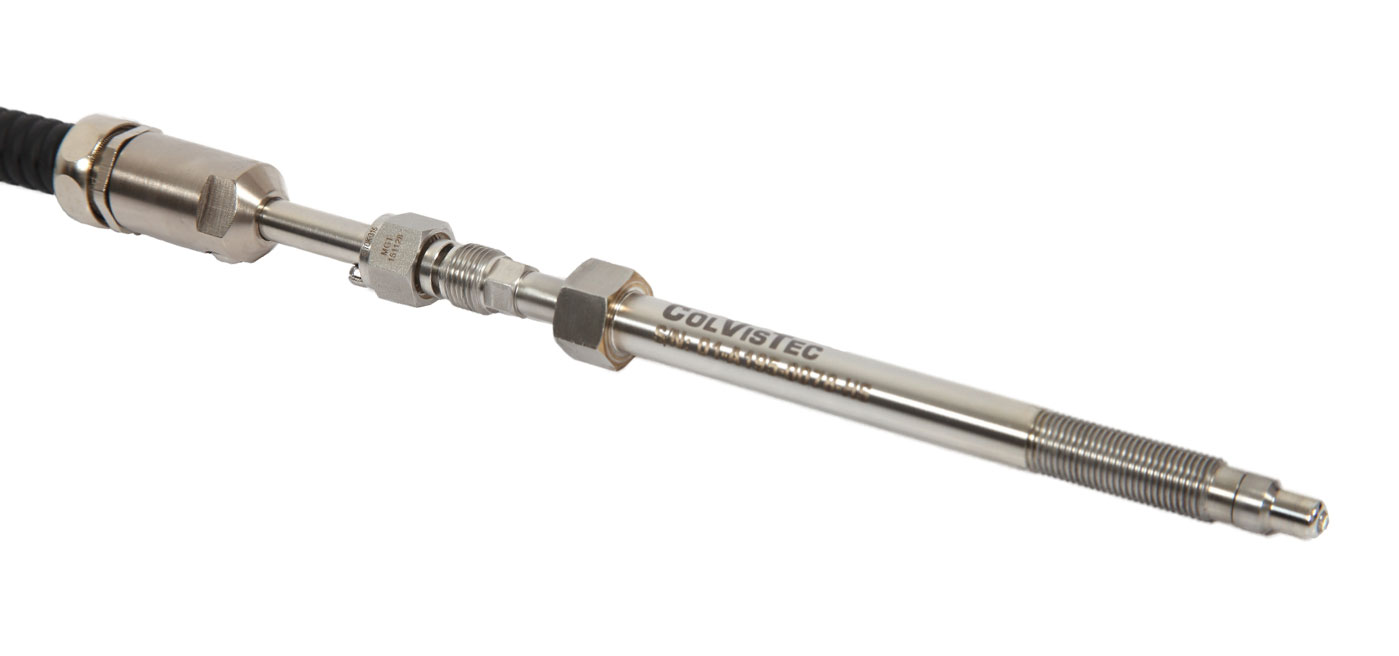
The RPMP consists of a probe body and a detachable
fiber optic. The probe is positioned in the
material flow at a suitable point in the medium
with laminar flow. The light is transmitted via
six fibers arranged in a ring and the portion of
the light reflected by the medium is detected via
a centered fiber.
As the fiber optics are removable, calibration can
be carried out outside the installation situation
using an external calibration adapter without
interrupting the ongoing process.
This probe is specially designed to withstand the high
temperature and pressure often found in
extruders, though it can also be installed in
other types of manufacturing machinery.
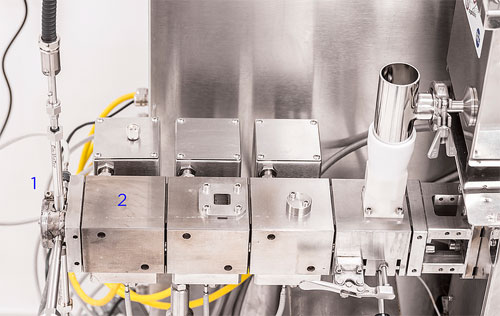
(1) The RPMP probe installed on (2) the extruder. For example, in the die-plate.
Reflection Probe Technical Data
- Consists of one fibre optic and one probe body units
- Thread Probe tip: standard thread 1/2”-20 UNF
- Wavelength range: 180-850 nm
- Fiber core diameter: 400 μm
- Numerical Aperture: 0.22
- Interface with spectrophotometer: FSMA 905
- Bending Radius (max.) 150 mm (5.9 inch)
- Standard fiber optic length: 5 m
- Maximum fiber length: 20 m (for very dark colors)
- Maximum fiber length: 50 m (for light colors)
- Sapphire semi-spherical window (self cleaning by material flow) embedded in Hastelloy
- Stainless steel body
- Length of the Probe body: 130 mm or 195 mm (5,1 or 7,7 inch)
- Separate fiber optic for easy calibration
- Pressure: ≤ 250 bar (3,625 psi)
- Working Temperature: -30°C up to 350°C (-22°F up to 662 °F) under special conditions: up to 400°C (752°F)
UV/Vis or NIR
Transmission Probes
The transmission probe — Transmission Polymer Melt
Probe (TPMP) — is available in two versions: as a
UV/Vis or NIR probe. Depending on the application,
these can be combined with the
Inline-Spectrometer InSpectro X
(UV/Vis) or with the
Inline-Spectrometer InSpectro NIR.
Designed for transparent/clear media, it is used
for a variety of applications in R&D as well as
directly in production plants, for example in the
transmission measurement of plastic melts in
extruders.
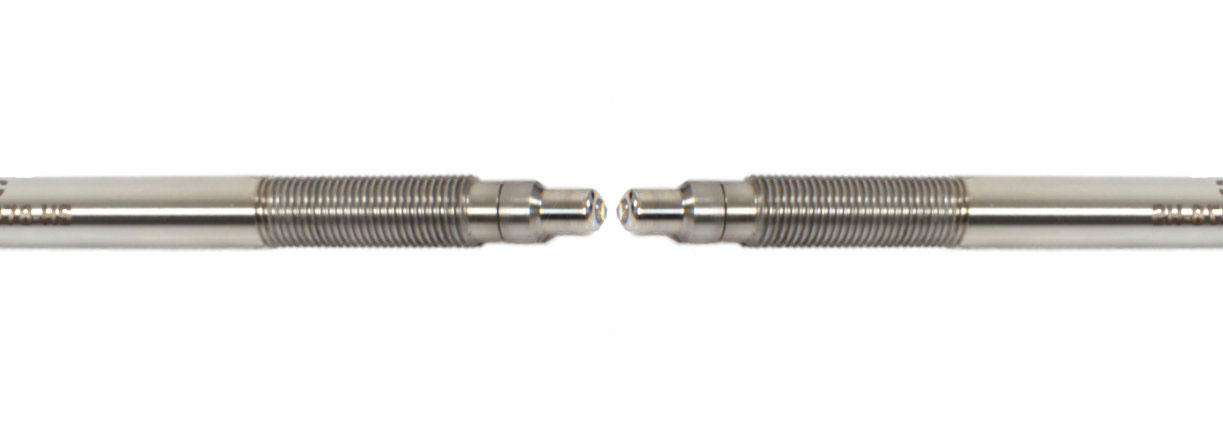
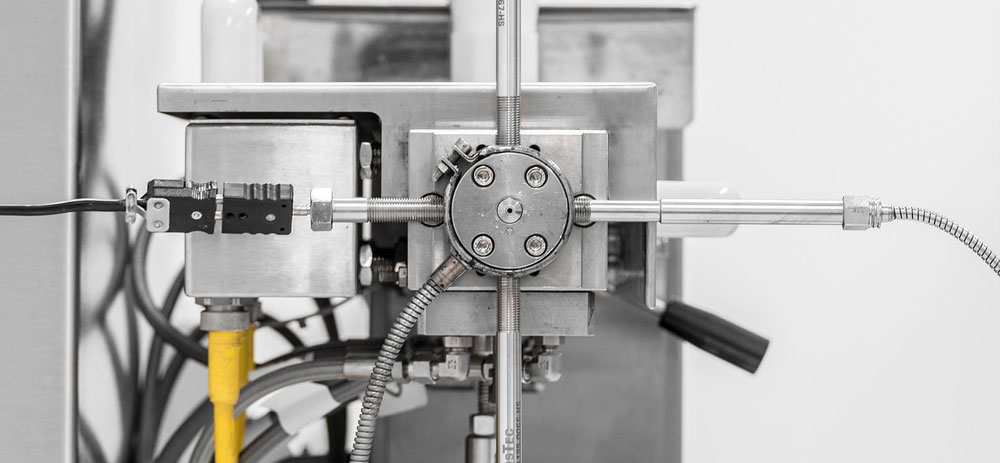
The TPMP consists of two probe sleeves and two
detachable fiber optics, which are installed
directly opposite each other (aligned) in the
material flow. One probe emits the light and the
other detects the light, which records the
characteristics of the medium to be measured
(spectra).
As the fiber optics are removable, calibration is
also possible outside the installation situation
using external calibration adapters and spacers
without interrupting the ongoing process.
Alternatively, it is also possible to calibrate to
air or the medium in the installation situation.
Transmission Probe Technical Data
- Consists of two optical fibers and two probe body units
- Thread Probe tip: standard thread 1/2”-20 UNF
- Wavelength range: 180-850 nm
- Fiber core diameter: 400 μm
- Numerical Aperture: 0.22
- Interface with spectrophotometer: FSMA 905
- Bending Radius (max.) 150 mm (5.9 inch)
- Standard fiber optic length: 5 m
- Maximum fiber length: 100 m
- Sapphire semi-spherical window (self cleaning by material flow) embedded in Hastelloy
- Stainless steel body
- Length of the Probe body: 130 mm or 195 mm (5,1 or 7,7 inch)
- Separate fiber optic for easy calibration
- Pressure: ≤ 250 bar (3,625 psi)
- Working Temperature: -30°C up to 350°C (-22°F up to 662 °F) under special conditions: up to 400°C (752°F)
Color Probe (CP)
The Color Probe (CP) is an accessory for use with
the ColVisTec Inline Color Spectrophotometer
InSpectro X. It is specifically designed for
reflected color measurements in direct contact
with the sample. The CP is suitable for liquid,
suspension / paste or powdery media, such as
paints, printing inks, granulates, etc.
The CP body of stainless steel is designed to fit
a standard 0.75-inch compression fitting.
Our Color Probe is usually used in Extruders where opaque liquids, paste, powder, or pellet materials are processed.
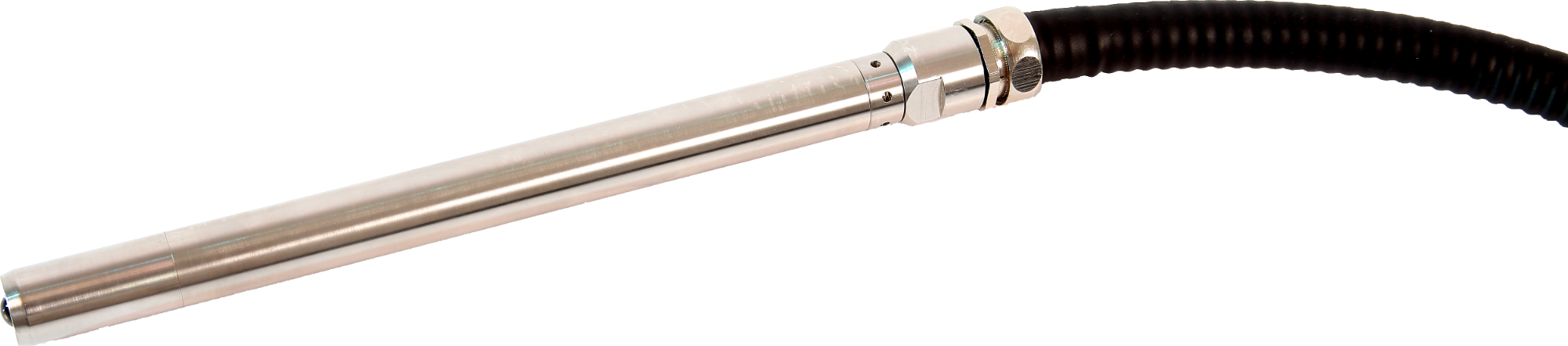
Color Probe Technical Data
- Sapphire window
- Fibre length: 5 m (standard)
- Stainless steel body (length: 240 mm, Ø 19.05 mm = 3/4 inch)
- Pressure: ≤ 15 bar
- Working temperature: -30 °C (not condensing) to 100 °C
- Maximum fiber length: 20 m (for very dark colors)
- Maximum fiber length: 50 m (for light colors)
2-in-1 Combined Probe with
UV/Vis and NIR Fibers
The Combined Probe is a unique accessory for use with
the ColVisTec’s Inline Spectrometer
InSpectro X and InSpectro NIR. It is specifically
designed to perform UV/Vis and NIR simultaneous measurements from a
molten polymer stream in an extruder. Combining
these two spectroscopy techniques is particularly
powerful in process optimisation and provides
remarkable process insights.
Again, the Combined Probe consists of a single probe
body that can be permanently installed into the
extruder, and a removable dual-fiber assembly that
transmits and receives UV-Vis and NIR light from
the sample at the same time and position in the process.
The Combined Probe is specificially designed for production processes to measure UV/Vis and NIR spectroscopy at the same measurement point. It can be used in the polymer, paint, pharma, food or chemical industry due to the standard thread for an easy implementation into the process.
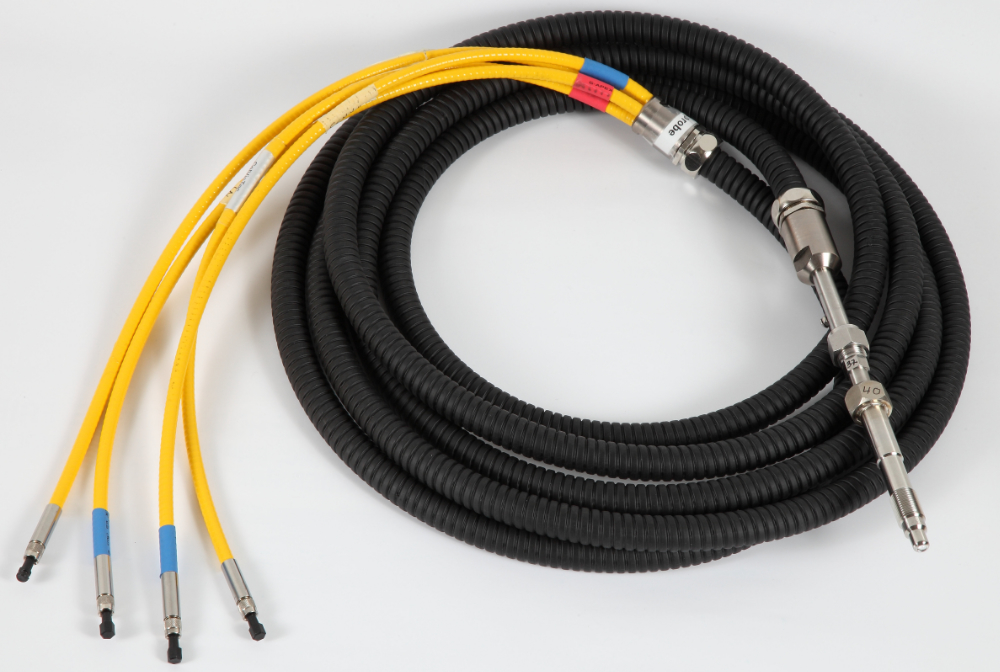
2-in-1 Combined Probe Technical Data
- Probe tip: standard thread 1/2”-20 UNF
- Consists of two fibre optic units
- Sapphire semi-spherical window (self cleaning by material flow)
- Separate fiber optic for easy calibration
- Temperature: ≤ 400 °C
- Pressure: ≤ 250 bar
- Stainless steel body
- Requires perfect in-line fitting
- Standard fiber length: 5 m
- Maximum fiber length: 20 m
Raman Inline Probe
The Raman Fiber Optic Probe is specifically designed to be used in combination with ColVisTec's Inline-Spectrometer InSpectro R , bringing high-performance Raman spectroscopy directly into the process. Built around a robust stainless steel body with an adhesive-sealed quartz window at the tip, the probe operates reliably under industrial conditions, withstanding working temperatures from −30 °C up to 350 °C (and up to 400 °C under special conditions). Like all ColVisTec probes, it mounts via the standard ½"-20 UNF (Dynisco®) thread, so it fits directly into extruder die-plates, adapters, flanges, reactors, or other process equipment — without requiring custom machining. Operating in reflection mode with a single probe, it features two dedicated fibers — one for laser excitation at 785 nm (105 μm, 0.22 NA) and one for signal collection (200 μm, 0.22 NA). The standard fiber optic length of 1.5 m, terminated with an industry-standard FSMA 905 connector, allows seamless integration with the InSpectro R spectrometer for continuous, non-destructive molecular fingerprinting directly in the production stream.
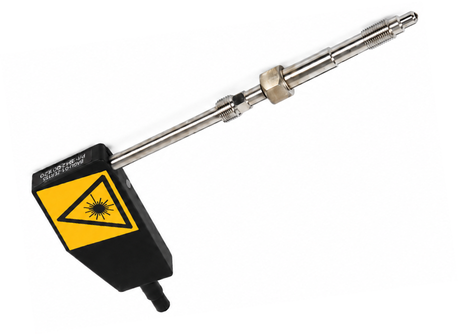
Raman Probe Technical Data
- Probe tip: standard thread 1/2”-20 UNF
- Consists of one Fiber Optic and one Probe Body
- Adhesive sealed Quartz window
- Separate fiber optic for easy calibration
- Temperature: ≤ 400 °C
- Pressure: ≤ 250 bar
- Stainless steel body
- Length of the probe body: 195 mm (7,7 inch)
- Standard fiber length: 1,5 m